
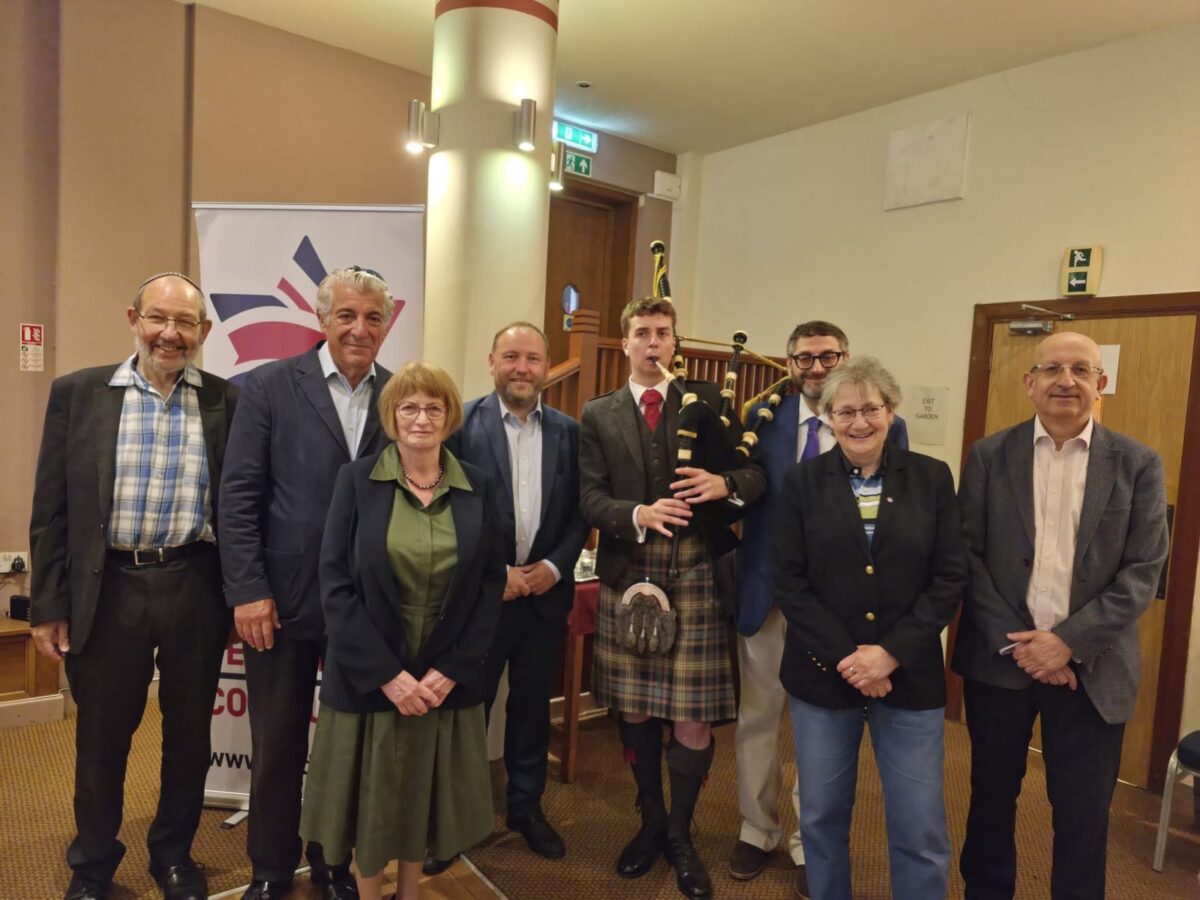
Recently I spoke at the regional plenary of the Board of Deputies of British Jews, which was held at the beginning of July in Edinburgh South.
It was the first time the board had held a plenary in Scotland in 20 years.
Read my full speech below.
Speech to the Board of Deputies of British Jews – Edinburgh
Shalom Aleichem.
It is a real pleasure to be here with you in Edinburgh, and to join you on such a significant occasion for Jewish life in this city, in Scotland, and across the United Kingdom.
This weekend, delegates from across the country have gathered here for the Plenary of the Board of Deputies of British Jews – the representative parliament of British Jews, made up of more than 300 deputies from communities and organisations across the UK.
The fact that the Board is meeting in Edinburgh for the first time in decades makes this a rare and important moment: a moment of recognition, solidarity and resolve.
I was deeply honoured to be invited by Edward Green to join you.
It is always a privilege to serve as an MP, but this is a special occasion because gatherings like this matter. At a time of real strain and anxiety for many Jewish people, they send a clear message: Jewish communal life in Britain is strong, resilient and will not be pushed into the shadows or diminished.
Today, I want to speak plainly about three things.
First, the value of the Jewish community to our country and our wonderful city.
Second, the seriousness of the challenge we all face with antisemitism.
And third, the action the government I represent is taking on security, education, institutions and community cohesion.
Let me begin with this.
The Jewish community is an integral, valued and cherished part of British life.
That is true here in Edinburgh, across Scotland and throughout the United Kingdom.
Jewish people should be able to live openly, safely and proudly as Jews.
To worship freely.
To gather confidently.
To send their children to school without fear.
To wear visible signs of Jewish identity without hesitation.
And to participate fully in public life without intimidation, hostility or concealment.
That is not a favour.
It is not conditional.
It is not negotiable.
It is a basic obligation of a decent democratic society.
And anything less will not be tolerated.
But for too many Jewish people, the opposite is the reality today.
We all know that this has not felt like an ordinary time.
There is a wider malaise around antisemitism in too much of our public life.
A coarsening of language.
A tolerance of conspiracy.
A habit of excusing what should be condemned.
A willingness to debate Jewish fear instead of listening to it.
Prejudice becomes dangerous not only when it erupts into headlines, but when it becomes normalised in institutions, campuses, online spaces and everyday conversation. That is how hatred embeds itself, and why it must be confronted early and consistently.
So let me say this as plainly as I can:
This Labour government, and all reasonable people, stand with the Jewish community.
We stand with you in defence of your security.
Your dignity.
Your freedom.
And your place in British life.
The first duty of any government is to keep people safe.
That is why the government has significantly increased financial support to the largest investment ever made by a UK Government in the protection of the Jewish community.
That is £58 million.
Alongside that, we have committed £18 million a year until 2028 through the Jewish Community Protective Security Grant, supporting synagogues, schools and community sites.
That funding means more patrols, stronger security and greater protection around the places where Jewish life is lived, taught and celebrated.
And when appalling attacks have happened, government has acted there too – including emergency support for Hatzola after the despicable arson attack in Golders Green.
That is what solidarity looks like when it is serious.
Not just words.
But resources, protection and action.
But if security is the first duty, it is not the only duty.
Because antisemitism does not just appear on the street.
It can surface in the very institutions people rely on.
That is why the government accepted in full Lord Mann’s recommendations following his review into antisemitism and racism in the NHS.
That includes mandatory antisemitism training, stronger accountability standards and practical measures to ensure Jewish staff and patients are properly recognised and supported.
No one should face prejudice in the very institutions meant to care for them.
Tackling antisemitism must mean more than condemning it.
It must mean changing systems, raising standards and enforcing accountability.
The same is true in education.
And here we need to speak with particular honesty.
Jewish students experienced a 413% increase in antisemitic incidents in the year following October 7, 2023.
That figure is shocking.
But behind that statistic are thousands of individual experiences, and for many, genuine trauma.
The trauma of walking onto a university campus and questioning whether it remains a place where you are safe; of feeling isolated, and uncertain whether speaking up will bring support or simply leave you to cope alone.
No student should have to carry that burden because they are Jewish.
Universities, colleges and schools should be places of learning, openness and confidence – not places of intimidation, fear and exclusion.
That is why the government is investing £7 million to tackle antisemitism across schools, colleges and universities.
It is why further work is underway to strengthen how schools, colleges and university campuses identify and tackle antisemitism, while Holocaust education remains central to our national story.
And can I thank the Edinburgh University Jewish Society for all their help, information, advice and guidance in my dealings with them.
Because remembrance matters.
Education matters.
And creating a culture in which Jewish students know they belong matters profoundly.
That question of belonging matters especially here in Edinburgh.
According to the Scottish Jewish Archives Centre, Edinburgh’s Jewish population has declined over the last century from roughly 2,000 to perhaps 500 or 600 today.
A community’s value is not measured in numbers.
But smaller numbers can mean less visibility, greater pressure on communal life and a sharper sense of vulnerability when people feel unsafe.
That is why gatherings like this matter so much.
Because in a smaller community, institutions are not optional extras.
They are anchors of identity, continuity, belonging and care, helping people know they are not alone.
So when the Board of Deputies comes to Edinburgh, it does more than hold a meeting.
It affirms a community.
It strengthens ties.
It says that Jewish life in Scotland is part of the wider story of British Jewry.
And it reminds us that representation matters, especially when communities are under pressure.
That brings me to community cohesion.
Too often, people speak as though supporting the Jewish community and promoting community cohesion are somehow separate goals.
They are not.
They are inseparable.
A cohesive society is not one where minorities are expected to become less visible or where threats against communities are downplayed for political convenience.
Real cohesion is built on equal citizenship, mutual respect, shared responsibility and the confidence that every community belongs and will be defended.
A strong society does not ask people to shrink themselves to fit in.
It gives them the confidence to stand tall.
That is one reason why the Drumlanrig Accords matter so much.
They are a landmark agreement between Muslim and Jewish religious leaders in the UK, rooted in shared values, ethical principle and a determination to choose dialogue over division.
When I first heard about the initiative I thought it was a brave, ambitious, but necessary project.
I remember the signing at Spencer House in February 2025, and I was proud to play my part in that journey.
The Accords were the result of sustained work led by Imam Dr Sayed Razawi, including a private retreat at Drumlanrig Castle here in Scotland, where Jewish and Muslim leaders came together with ministers and officials from the UK Government, the Scottish Government and the European Commission.
What made that process so important was not ceremony, but trust.
It showed that peace is built patiently.
That cohesion is built through relationships.
And that when faith communities, institutions and government come together seriously, they can create something of lasting value.
The message it sent out was that peace, community cohesion and mutual tolerance was to be celebrated and the building block of our communities.
For the first time in UK history, senior representatives from major Muslim and Jewish traditions came together to shape a framework based on shared values, reconciliation and social responsibility.
And I believe the Accords have already helped strengthen the relationship between Jewish and Muslim communities in this country.
Congratulations to all involved in making this historic accord possible. They even got to present it to His Majesty the King at Buckingham Palace.
The Accords sit comfortably alongside the annual candle-lighting ceremony that multifaith leaders, community champions and politicians participate in to show mutual solidarity. The mutual lighting of a simple candle meaning so much.
They are a reminder that another path is possible.
A path of dialogue.
A path of respect.
A path of shared moral purpose.
And in a time of tension and division, that matters enormously.
That is also the thinking behind the government’s broader cohesion agenda.
The Ministry of Housing, Communities and Local Government’s Protecting What Matters strategy sets out a whole-of-society response to extremism and division.
It includes additional funding for communities facing antisemitism, support for interfaith programmes and local initiatives, and stronger coordination across government to tackle extremism and division.
All of that reflects a simple truth:
Cohesion does not just happen.
It has to be built.
Protected.
And renewed.
In the modern world, that also means taking seriously the information environment in which we all live.
Social media has accelerated the spread of misinformation and extremist narratives, shaping attitudes offline, fuelling hostility and deepening division.
So if we are serious about cohesion, we must also be serious about the media ecosystem.
That is why my ministerial department, the Department for Culture, Media and Sport, is focused on ensuring our media system supports democracy, public trust and a better informed society.
Because falsehood thrives where scrutiny is weak.
And because the fight against antisemitism is also, in part, a fight for truth.
Government is also strengthening the legislative framework to counter malign actors, protect places of worship and ensure communities can gather, worship and live free from intimidation, while maintaining the right to peaceful protest.
That balance matters.
The right to protest matters.
But so does the right of Jewish communities to worship, gather and live without fear.
A serious democracy protects both.
And beyond legislation, the Prime Minister has brought together leaders from across public life to drive a whole-of-society response to antisemitism.
Because this burden cannot fall on Jewish communities alone.
It is a responsibility for government.
For police.
For schools and universities.
For faith leaders.
For local authorities.
For media organisations.
And for civil society as a whole.
Because antisemitism is not just a Jewish problem.
It is a national problem.
A test of our values.
A test of our seriousness.
And a test of whether we really mean what we say when we speak about decency, equality and respect.
So let this weekend in Edinburgh be remembered not only as the first Board of Deputies Plenary held here in more than twenty years, but as a declaration of confidence – in this community, in Jewish life across the UK, and in the values that bind us together.
A confident country does not ask its minorities to be quieter.
A cohesive country does not leave any community to face hatred alone.
And a decent country does not equivocate about antisemitism.
It confronts it.
It stands with those targeted by it.
And it defends the right of Jewish life to flourish openly and proudly.
Because this is about more than policy.
More than funding.
More than legislation.
It is about whether a Jewish child in this country grows up feeling safe.
It is about whether a Jewish student can walk onto campus without fear.
It is about whether a Jewish family can come to synagogue, celebrate a festival, mark Shabbat, or live out their faith not anxiously, not quietly, not looking over their shoulder – but freely, fully and with pride.
It is about whether we are the kind of country we still believe ourselves to be.
And I believe we must be.
A country where Jewish life is not merely protected, but cherished.
A country where difference is not feared, but honoured.
A country where hatred is not managed, but defeated.
A country where people do not retreat into silence, but stand together in courage.
So let us be equal to this moment.
Let us answer fear with solidarity.
Let us answer hatred with courage.
Let us answer division with fellowship.
And let us answer antisemitism with an unshakeable determination that Jewish life – proud, visible, joyful, faithful Jewish life – will flourish here in Edinburgh, will flourish in Scotland, and will flourish in the United Kingdom for generations to come.
That is what this Labour government is committed to doing.
That is what I am committed to doing.
That is what we should all be determined to do.
We stand together.
And that is why it is such an honour to be with you here today.
Thank you.